
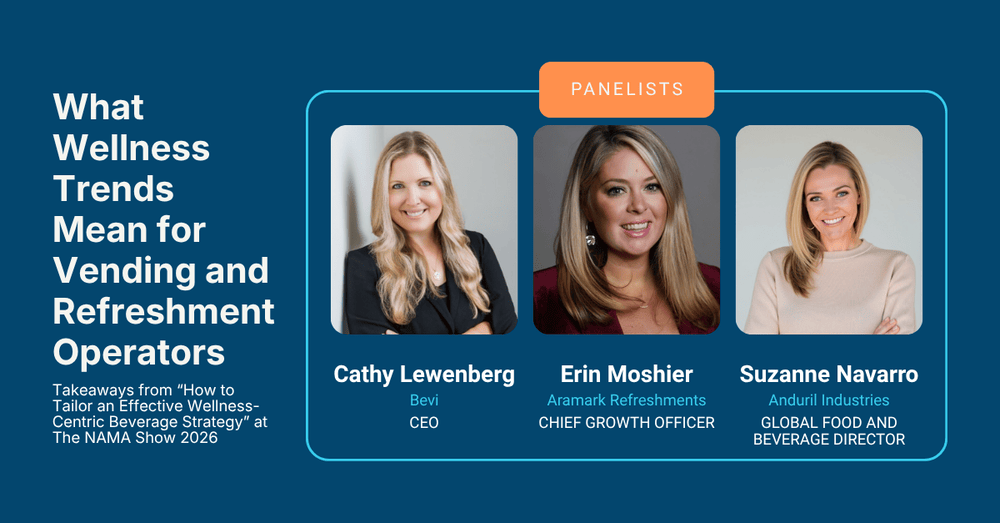
Takeaways from “How to Tailor an Effective Wellness-Centric Beverage Strategy” at The NAMA Show 2026
By Becca Woll
Employee expectations are rapidly evolving. Wellness is a priority, not just a perk. In the session “How to Tailor an Effective Wellness-Centric Beverage Strategy” on Wednesday, April 22nd at The NAMA Show 2026, speakers delivered a clear message to vending and refreshment operators: become strategic partners with clients or risk losing business.
The panel featured Erin Moshier, chief growth officer at Aramark Refreshments, and Suzanne Navarro, global food and beverage director at Anduril. Cathy Lewenberg, CEO at Bevi, moderated the discussion, which explored how operators can rethink beverage programs for a more health-conscious, experience-driven workplace that ultimately drives stronger business outcomes.
The GLP-1 Effect: A Shift Operators Can’t Ignore
One of the most notable themes was the growing impact of GLP-1 medications on consumer behavior. Lewenberg said 30% will be taking it by 2030, while Moshier emphasized that one in five people by 2030 will be on it, so that’s significant.
These users are often key decision-makers in workplaces as well, meaning their preferences will increasingly influence product selection. Navarro framed it as more than a passing trend, even if it is not yet widely discussed.
For operators, this signals a need to rethink product mix and forecasting. Lower consumption, different cravings, and a stronger emphasis on health outcomes could reshape demand. As Moshier put it, understanding “What’s the impact on healthcare costs?” allows operators to approach clients more strategically. Instead of “what snacks or beverages do you need?” it becomes “how can we support you?”
The Power of Choice and Customization
If there was a central theme, it was flexibility.
“A successful program should mirror geographical tastes in wellness,” Moshier said. “Nobody likes a generic program.”
Today’s consumers, especially younger generations, expect personalization in nearly every aspect of their lives, including workplace food and beverage. This means operators need to move beyond one-size-fits-all solutions and tailor offerings to each location’s demographics, preferences, and wellness goals.
“The power of choice,” according to Moshier, is critical.
Her team approaches this with a scalable model: a “standard backbone” that ensures consistency while they “humanize the edges” through localized customization.
Behavior Over Data: A New Lens for Decision-Making
At Anduril Industries, Navarro takes a complementary approach, focusing less on traditional metrics and more on behavior.
They focus on one question: “What are the behaviors, instead of the statistics?”
Serving a diverse workforce that includes millennials, Gen Z, Gen X, and veterans, Anduril recognizes that behavior shifts when groups interact. When different generations gather in one space, they form what Navarro described as their own ecosystem. As a result, the company maintains staples while expanding healthier variety without adding complexity.
For operators, this insight is key: understanding how people actually use spaces can be more valuable than static data points. Moshier also noted that many organizations end up retrofitting programs, making it important (when possible) to build from the ground up with behavior in mind.
Navarro further stressed the importance of building flexible systems rather than rigid long-term plans: “Don’t plan five years ahead. Create the background.”
Designing for Experience, Not Just Consumption
Another major shift discussed was the growing importance of workplace experience.
“Employer experience is more important than ever,” Moshier said, urging operators to think beyond machines and products. Instead, the focus should be on moments and environments.
She encouraged operators to ask, “What kind of experience do you want your employees to have?” and emphasized the need to “be intentional with the program.”
Sometimes, that experience has little to do with beverages themselves, such as warm cookies arriving at the workplace at the right time. These moments build culture and engagement in ways traditional offerings cannot.
Navarro reinforced this idea with a simple directive: “Build destinations.” When done right, food and beverage spaces become central to workplace connection and even retention. As she put it, “Food and beverage is an important component for tenure.”
Rethinking Partnerships
A key takeaway for operators is the need to evolve from vendor to strategic partner.
“Pick partners, not vendors,” Navarro emphasized. Consistency and adaptability are critical.
She outlined questions organizations are increasingly asking:
- “Can they be as fluid?”
- “Can they move as quickly as us?”
- “Can they challenge the conversations in a meaningful way?”
Operators are no longer just providers; they are collaborators expected to bring insight, agility, and innovation.
Where AI Fits In
AI is already playing a role, but it is not replacing human judgment.
Moshier said her team uses AI for heatmapping and operational insights, noting: “Give AI the data, then navigate.” This helps improve efficiency and demonstrate cost savings to clients.
Navarro offered an equally grounded perspective: “AI informs, but doesn’t define it for us.”
For operators, this reinforces that AI is a tool, not a strategy. The real value comes from how insights are applied.
What This Means for Operators
The session made clear that wellness-centric beverage strategies are not just about adding healthier drinks. They require a broader rethink of how programs are designed, delivered, and experienced.
Operators that succeed will anticipate shifts like GLP-1-driven consumption changes, prioritize customization, focus on behavior as much as data, design for experience, and act as strategic partners.
As workplace expectations continue to evolve, so too must the role of the operator. Better yet, those who embrace this shift will help shape it.
Share this Story
Related Posts