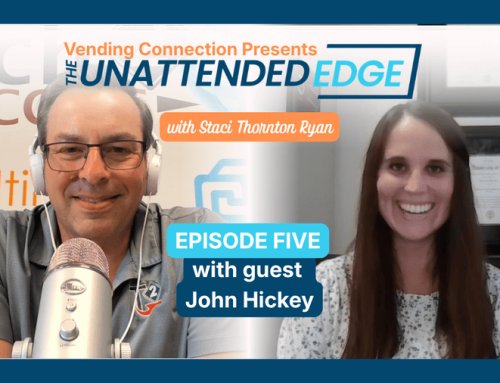

The second episode of The Unattended Edge continues to deliver practical, real-world insight for the convenience services industry—this time through the lens of mergers and acquisitions.
Host Staci Thornton Ryan sits down with Charlie Giacona of Continental Services to unpack what really happens when operators are evaluated, acquired, and integrated—and what separates strong businesses from struggling ones.
The conversation blends operational fundamentals with strategic perspective, offering a rare look “under the hood” of unattended retail businesses.
A View from Both Sides of the Table
Giacona brings a unique perspective to the discussion. Having grown up in a family-operated business before joining Continental, he understands both the scrappy, day-to-day reality of independent operators and the structured approach of a larger organization.
That dual experience shows up throughout the conversation. Operators, he explains, are often incredibly resourceful—solving problems on the fly, keeping customers happy, and making complex operations look effortless.
But beneath that smooth surface is constant motion.
As Giacona describes it, the industry often resembles “a duck on water”—calm above the surface, with intense activity underneath. From last-minute product runs to route adjustments, much of the effort goes unseen by customers.
The Hidden Gaps: Taxes, Contracts, and Compliance
One of the first areas Continental evaluates during an acquisition is something many operators overlook: taxes.
Even well-run businesses can have misconfigured tax settings, especially when operating across different states or jurisdictions. These errors are rarely intentional, but they can be significant.
Giacona notes that while many operators are “close,” when something is off, it can be off by a wide margin—often due to changing regulations or lack of specialized expertise.
The takeaway is simple: tax accuracy isn’t optional, and operators benefit from expert guidance, whether internal or external.
Contracts are another common gap.
While many operators rely on long-standing relationships instead of formal agreements, Giacona makes the case that contracts are essential—not as a sales tool, but as protection. They provide stability when customer contacts change and ensure operators can recover the cost of equipment investments.
Still, Continental doesn’t lead with contracts during integrations. Instead, they focus on proving value first—then formalizing the relationship once improvements are made.
Retention Starts with Respect
Employee retention, especially post-acquisition, is another critical focus.
For Continental, the priority is clear: keep the people who already know the customers.
Route drivers, service technicians, and warehouse staff are often the true face of the business. In many cases, their relationships with clients are stronger than the company’s brand itself.
Rather than forcing immediate change, Giacona emphasizes a slower, more deliberate approach—explaining the “why” behind decisions, pairing new employees with experienced team members, and demonstrating long-term opportunity.
Benefits, scheduling flexibility, and operational improvements like pre-kitting also play a role. But the biggest differentiator is communication.
When employees understand how changes make their jobs easier—and more efficient—they’re far more likely to buy in.
Focus Matters: Don’t Try to Be Everything to Everyone
One of the most practical takeaways from the episode centers on focus.
Operators face constant pressure—from suppliers, customers, and new technologies—all needing attention. But trying to do everything can dilute performance.
Product selection is a prime example.
While the temptation is to offer endless variety, data consistently shows that a small percentage of products drive the majority of sales. Overloading machines or markets with low-performing items wastes valuable space and reduces profitability.
Instead, Giacona took a more intentional approach:
- Prioritize top-selling items
- Test new products selectively
- Rotate underperformers strategically
In some cases, the best solution is surprisingly simple. If a decision-maker requests a niche product that won’t sell broadly, provide it separately—without sacrificing valuable machine space.
The Case for VMS: From Guesswork to Precision
If there’s one theme Giacona returns to repeatedly, it’s the importance of a robust VMS (Vending Management System).
Without it, operators are essentially guessing—visiting locations too often, missing high-demand stops, and losing money on inefficient routes.
With it, everything changes:
- Route frequency becomes data-driven
- Inventory is optimized
- Pricing adjustments can be made remotely
- Labor and service costs are reduced
The impact is immediate and measurable. Operators can cut unnecessary visits, increase sales per stop, and free up time to focus on growth.
In an industry where each service call carries real cost, that level of visibility isn’t just helpful—it’s essential.
Small Changes, Big Impact
Throughout the episode, a consistent theme emerges: success in unattended retail doesn’t come from one big move—it comes from doing the fundamentals well.
That includes:
- Accurate tax setup
- Thoughtful contracts
- Employee engagement
- Focused product strategy
- Data-driven operations
For operators juggling countless responsibilities, it’s easy to get pulled in multiple directions. But as Giacona points out, being intentional about where time and energy go can make all the difference.
A Practical Playbook for Operators
Episode 2 of The Unattended Edge reinforces what many in the industry already know—but don’t always prioritize.
Behind every successful operation is a combination of discipline, adaptability, and continuous improvement.
By blending frontline experience with enterprise-level insight, Giacona offers a roadmap that operators of any size can apply—whether they’re preparing for growth, considering a sale, or simply trying to run a better business.
As the series continues, The Unattended Edge is quickly establishing itself as a valuable resource for operators looking to sharpen their edge in an increasingly competitive landscape.
Share this Story
Related Posts