
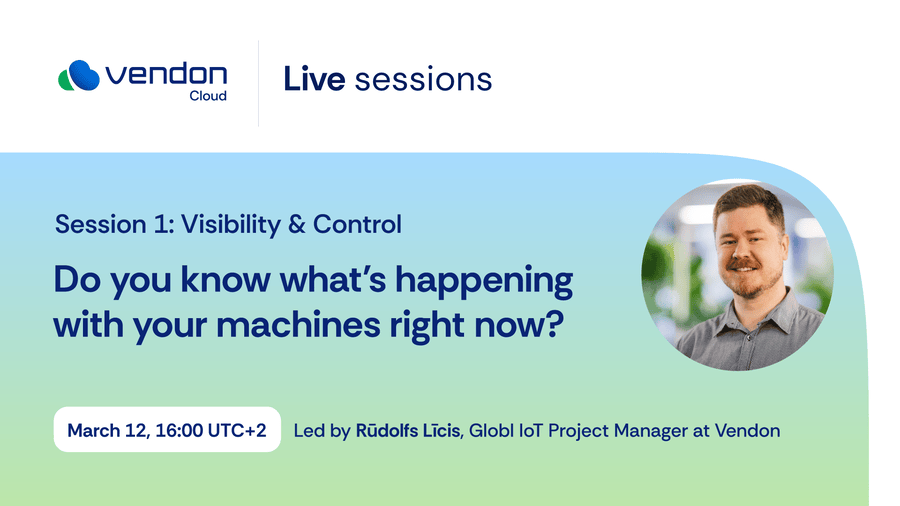
Watch Now: https://rebrand.ly/Vendon-Cloud-session-1
Insights from Vendon Cloud Live Session I with Rudolfs Licia, Global IoT Project manager at Vendon
Most vending operators know how much their machines sold last month.
Far fewer know how much they could have sold.
That’s where some of the biggest profit opportunities in vending and office coffee service are hiding today. Not in new locations. Not in new equipment. Not in squeezing another price increase into the market.
They’re hiding inside machines that already exist.
During Vendon Cloud Live Session Rudolfs focused on a challenge that affects operators of every size: making business decisions without having the full picture.
The conversation centered on visibility, but the real business issue is profit. More specifically, the sales that never happen because operators don’t know enough about what’s happening between service visits.
As Rudolfs explained, most operators still rely on a combination of route visits, customer feedback, and periodic reporting to understand how their machines are performing. The problem is that customers are buying products every day, while operators may only see the machine once a week.
A lot can happen in between. And that’s often where profit starts to disappear.
When a machine looks healthy but isn’t performing
One example discussed during the session illustrates the problem perfectly.
A vending operator was regularly receiving complaints about product availability. Customers insisted that popular items were always sold out, while the route team maintained that the machine was being serviced correctly.
Both sides believed they were right.
When sales and inventory data were reviewed, the operator discovered that three products generated almost 60% of all sales while occupying less than 20% of the machine’s capacity. Those products consistently sold out several days before the next refill.
Meanwhile, slower moving products remained fully stocked.
From the operator’s perspective, the machine looked full.
From the customer’s perspective, it looked empty.
The machine wasn’t suffering from a stock problem.
It was suffering from a sales opportunity problem.
The solution wasn’t another route stop, another driver, or another machine. The operator simply adjusted product allocation based on actual demand.
The result was improved product availability and recovered sales without increasing operating costs.
For many operators, this is where telemetry delivers its biggest value. It doesn’t create demand. It helps operators capture the demand that already exists.
The revenue leak nobody noticed
The same principle applies in office coffee service.
Rudolfs shared an example of an operator who noticed that a customer had significantly reduced coffee bean purchases. Like most people would, the operator initially assumed consumption had fallen.
But consumption data showed something completely different.
Employees were drinking roughly the same amount of coffee as before.
The missing revenue wasn’t caused by lower demand. The customer had simply started sourcing coffee elsewhere while continuing to use the operator’s machines.
Without machine-level consumption tracking, the operator might have accepted the lower orders as a normal change in customer behavior.
Instead, they discovered a revenue leak that had nothing to do with coffee consumption and everything to do with visibility.
This is one of the less obvious benefits of telemetry. It doesn’t just show what machines are doing. It helps operators understand what customers are doing.
Managing a fleet with facts instead of assumptions
Throughout the session, Rudolfs repeatedly returned to one theme: better decisions come from better information.
That applies to inventory management, machine performance, route planning, stock levels, technical events, and customer service.
For example, if a machine is fully stocked and performing normally, does it really need a visit? If another machine is running low on its best-selling products, should that machine be prioritized first?
If a technical issue appears, does it require immediate action or can it wait until the next scheduled stop?
Without data, those decisions are often based on assumptions.
With real-time machine monitoring, operators can prioritize resources where they have the greatest business impact.
That becomes increasingly important as fleets grow. A handful of unnecessary visits may not seem significant, but across hundreds or thousands of machines, route inefficiencies quickly become a labor and profitability issue.
Visibility is not the goal. Profit is.
One of the most important takeaways from the session was that telemetry should not be viewed as a technology investment.
It is a business tool.
Operators are not looking for more dashboards. They are looking for ways to improve machine performance, reduce wasted effort, protect customer relationships, and increase profitability.
The machine that looks full but is losing sales.
The customer whose coffee consumption hasn’t changed but whose purchasing behavior has.
The route stop that doesn’t need to happen.
These are not technology problems.
They are business problems.
And increasingly, operators are using machine data to solve them.
Because in today’s vending and office coffee market, growth doesn’t always come from adding more machines.
Sometimes it comes from understanding the machines you already have.
About Vendon
Vendon is Europe’s leading connectivity platform for mixed vending and coffee machine fleets of any size, working globally with a presence in over 110 countries. Our platform is focused on usability, achieving your business goals, and growing your profit.
Share this Story
Related Posts